Jan 16, 2005
The trial that I was part of as juror number three has come to an end. It began on December 8th of last year and ended this year on Friday, January 14. There was a holdover during the holidays of several weeks and then we continued on January 3rd.
For me this was not an oppressive ordeal although it was certainly long and difficult. Being retired removes from you the discipline that work imposes. It was not an unpleasant task because I wanted to be on a jury in the first place. And that's why I did not postpone it when I received my summons in the mail. Indeed, I found it extremely rewarding. To be sure, one does get tired, day in and day out. It's not a physical tiredness but, rather, emotional exhaustion that sets in. The climax of that fatigue came with the delivery of the verdict. More about that, but later.
This trial was an age-old tale of temptation and greed. The charge was embezzlement, defined as the fraudulent appropriation of funds or property entrusted to your care but actually owned by someone else. In this case a lawyer and her partner were entrusted with a great sum of money, (more than $600,000), by a Kuwaiti family who wanted to shield the money from possible seizure by the Kuwaiti government. The lawyer had represented the family when they immigrated to the United States. But her legal assistance was to no avail. After several years of appeals, the patriarch of the family was deported and then imprisoned in Kuwait. The mother and her five children remained here. The family savings, in a scheme devised by the lawyer and her partner, was to be sheltered by transferring the money from the Kuwaiti account to the lawyer's trust account. From there she set up a corporation that would supposedly invest it, buy a building or buildings and provide for the "present and future care" of the minor children, according to a contract drawn up between the parties.
But to be invisible to possible seizure by the Kuwaiti authorities the corporation was chartered only in the name of the lawyer and her partner. The Kuwaiti and his wife's name appeared nowhere in the listing of the corporation and its accounts. But why not? After all, they trusted their lawyer to proceed in good faith and to defend their interests. After all, she had done yeoman work in trying, albeit unsuccessfully, to prevent her client's deportation. Their faith was misplaced. Trust was nowhere to be found.
Thus began a long and diabolical process of methodically draining the assets of this dummy corporation. First a building was purchased in downtown Brooklyn. A business, an internet cafe, was established in the ground floor. The second floor was rented to a bail bondsman. The third and fourth floors were, on and off, rented to residential tenants. Loans were taken on top of the monies that were in the account, using the very assets as collateral. The defense tried to present this as a "business deal gone bad." And sloppy business is not a crime", they opined.
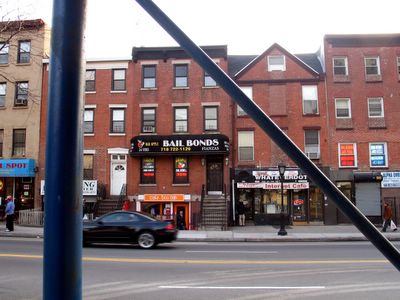
The trial focused on this building in downtown Brooklyn.
But in the several years that ensued, hardly a penny of the monies was dispensed to this woman and her five children, the rightful owners. I guess the defendants assumed that their client had placed her faith in them, that she spoke not a word of English, that she was all alone, that she feared the authorities, having already done battle with them in her own country and then with new governmental forces upon arriving here. I guess they presumed she would not dare complain or go to the police. Don't assume. Becuase she finally did and the District Attorney brought these charges of grand larceny on which we were being called to ajudicate.
We were very careful to follow the judge's charge to the jury. We bent over backwards to presume innocence. And we were determined to pore through the voluminous documentary evidence - piles of bank statements, copies of checks, contracts, retainers, etc. I'm proud of the way we worked because no one on that jury relished the thought of possibly sending two individuals to prison and ending a person's hard won law career.
The evidence, however, would not leave us (or our presumption of evidence) alone. The paper work was so terribly sloppy or missing altogether that it became increasingly hard to explain it as "bad business" practices. Loans were taken when they were not needed and the money so-gained was spent away as well. The defendants, themselves, moved into one of the apartments in the purchased building and lived their rent free for years! Even while the Kuwaiti woman and her five children, the genuine owners of the property, were left unattended to fend for themselves. Examining the bank records, we saw countless debit transactions that were made for several trips to Europe, Las Vegas, the Carolinas and Atlantic City. There were many purchases that were made for restaurant meals, men's clothing, toys and many other items that had nothing to do with running the business that had been set up. Checks in ten and fifteen thousand dollar denominations were written by the defendants to the defendants.
The jury got angrier and angrier as this evidence was pored through and the truth became clearer and clearer that this was not sloppy business but, more properly, monkey business. The utter lack of concern for their clients, their treatment of the arrangement they had devised, as the D.A. put it, as a "money printing machine" ... all of this slowly but inevitably pushed us jurors to finally, after two long days of deliberation, deliver a unanimous verdict of guilty.
I was struck by the democratic aspect of being a juror. Perhaps there is no other institution in our society and government that is quite as democratic as the jury system. (It hasn't always been that way; witness the lily-white juries of the South, which, for years, were rigged against African-American citizens). That was a great advance in human civilization when society freed itself from the whims of the ruling establishment and decided that you are to be judged by a jury of twelve of your peers. Of course, I'm not naive to believe that there are still not gross inequalities in the system of justice in our country. This regards the ability of wealth to buy the most skillfull and persuasive lawyers, class and racial bias in the way laws are written and enforced, etc. But I still believe that the jury system is fundamentally a democratic and progressive aspect that must be preserved. And sitting upon a jury would serve to reinforce that feeling. I urge my friends and BLOGgards not to hesitate if the opportunity comes their way.
The jury I sat on was a microcosm of Brooklyn. There were men and women, Black, Latino and white. Poor and not-so-poor. Educated and not. We worked together as a cohesive group. There was no animosity or elitism. But there certainly was a wonderful bonding as we hammered out a verdict. And we all acknowledged, sadly, the difficulty of entering a guilty plea. This was evidenced by the demeanor of the forewoman, a Black woman, who stood to announce our decision. The moment was filled with electricity as she stood and faced the judge to pronounce, in a trembling voice, the defendants guilty. Should she look at the defendants or avert her eyes? Each and everyone of us had to make the same decision as the individual jurors were polled. It's not an easy moment.
We were all very impressed with the judge who treated the jury throughout the trial with great respect and deference. On the wall behind the jury box was a photo of Paul Robeson. On the back wall of the courtroom, a print of striking coal miners. This was a guy with a social conscience, I thought to myself. And he conducted the trial in a like manor. Over and over he stressed to us that we were to consider the defendants innocent until the very end when we would deliberate. He spoke to us about the history of that concept and how it stands at the bedrock of our democracy.
So the trial is over. I don't know what the sentence is for the charge involved but it probably involves a prison sentence. What motivated this young lawyer, whose earlier years were filled with idealistic and altruistic activities (she defended the People's Firehouse (a protest to the closing of firehouses in poor neighborhoods in Brooklyn), worked on cases defending immigrants' rights and homeless, etc.) to mire herself in this web of deceit? How could she turn her back on her client, on a woman and a family that needed her help and, instead, descend into the murky depths of greed and thievery? I had been impressed by her testimony. Sometimes you have a gut impression abut a person and I did with this defendant. She was appealing to me. I liked her manner and the way she spoke (softly). I admired her history and, being a Black, woman lawyer also spoke volumes: here was a woman who had to fight and struggle to become a lawyer. And somehow, it seems, she stumbled, succumbed to temptation and now, so sadly, has thrown it all away. (I subsequently learned that she had been disbarred from practicing law in New York). What a tragic ending.
Jan 12, 2005
Last year being the 100th anniversary of the New York City Subway, I attended an "author's talk" at the Central Library last night. Two guys, Stan Fischler and John Henderson have written an enormous book (568 pages and 400 photos!): The Subway And The city and the talk was accompanied by a slide show with some wonderful photos of early subway construction and the like. I found it very interesting to know that our subway, begun in 1904, was the first urban rapid transit system in the world. The technology was invented on the fly.
New York in 1904 was somewhat of a small town compared to the metropolis of today. Brooklyn, Queens and the other outer boroughs still contained vast areas of trees and fields. It was the subway that, as it was built, invited development along and beyond its tracks. As the subway was built, so too was the city that we know today.
The book, which Mr. Fischler signed, contains hundreds of unique photos and has chapters on, what was an institution for millions of New Yorkers: boarding the subway for a trip to the Coney Island beach or to the city's ball parks. Fischler is the soul of the book as he describes how the subway shaped the people of our city. His counterpart, John Henderson is techie of the duo. His contribution describes the technology that was invented and refined to make the New York City subway a reality.
During the talk, both alluded to the beauty and diversity of our city and its unique subway system. It was (and is), they said, the great unifier that allowed people (New Yorkers)of all classes, races, nationalities and backgrounds to mix it up by riding together under the streets of our city. But both also told of a subway whose great promise, development and expansion was cut short through lack of financing and support from political leaders such as Robert Moses who were in the thrall of the oil, automotive, tire and highway lobbies which competed with mass transit for financing and domination of our cities. We know who won that battle. It was no contest.
 Stan Fischler, signing a copy of his book. The author grew up on Marcy Avenue and remembers in 1935 the construction of the subway in front of his house.

John Henderson expounds while Stan Fischler autographs, after the Author's Talk at the Central Library.

IRT Subway construction in 1904 using the cut and cover technique.

Flyer, advertising the meeting at the Central Library.
Jan 9, 2005
Stephanie is back. With Emily. Every so often, Stacey's first cousin's daughter comes to town. That is to say Stephanie, from Atlanta. Stef is a designer and manufacturer of youthful sportswear: such as rhinestone-emblazoned thongs and t-shirts and other cool things like that. She's been quite succesful. Emily, who works for Stephanie but lives in Jacksonville, came in this time as well to assist at the show. The "show" refers to the Intermezzo show at the piers on the west side of Manhattan. When Stef comes to town she usually stays with us. This is the first time in our new apartment though.
Stacey is visiting and helping Dani and Erik with their new house in Saratoga (upstate NY) and so I would have been all alone but for this visit of two nice, young, attractive women. Could be worse.
Tonight, when the girls returned from the show, we had some guacamole that I prepared, then off on a short walk to City Lighting - a lighting store turned bar/restaurant. It was just OK but anyway, a convenient 2 block walk from the house.
 Stef and Emily on our way to City Lighting on Flatbush.
 The same duo.

Me, at City Lighting. Photo by Stephanie.

Stephanie and her Decaf.

After dinner on Flatbush Avenue.

Two southern girls trying to stay warm in New York City.
Tomorrow - back to jury duty once again. The judge tells us we're "almost done". He said it might be over by mid-week. We'll see.
Jan 5, 2005
Supposed to snow, rain and sleet today. Oh Joy! For me - back to jury duty. We were on hiatus for the holidays - the judge feared that the jurors would rush to judgment with the festivities pending and thus, adjournment. Forgot my fellow jurors' names in the meanwhile. We'll have to introduce ourselves around once again.
On to my bike (that's how I get to court) and on with the trial!
Jan 3, 2005
...just been busy. Besides, I haven't been in a writing mood. Holidays came and went. Didn't really feel like they were here. Is that a product of my age and station in life? Or am I just inured to the never-ending hoopla and rampant commercialization. Am I rejecting the consumerism that pervades our society? Dunno. But this year, more than ever, I just didn't feel any excitement and in the past I have.
Got a sad letter today: Raleigh Camera, a "competitor" of my store and an equally long-standing Brooklyn institution and camera specialty store is closing its doors this month. "Equally long-standing" refers to the camera store that my grandfather, father and then my brother Lee and I ran for so many years: Mayfair Photo. We closed it two years ago July. The cessation of business was a long time coming but the handwriting had been written on the wall. Photography, as a retail enterprize, is a "sunset business" as the Japanese like to say. Meaning, it's in decline. Why? I guess Kodak would like to know the answer to that question as well since they've been suffering so greatly. Digital, which has transformed all human endeavor, certainly is a large part of it: with digital has come the loss of film and processing sales. Processing was a mainstay of our profits at Mayfair and all camera stores.
But there's more: the very nature of retailing has changed so dramatically. Mail order combined with the power of the web lets you see and order any item you want with enough information and visual clarity to satisfy many buyers. From the comfort of their easy chair. And then it's delivered in a day or two right to their door. Don't like it? Send it back. Doesn't happen too often with me. It's very seductive and it accounts for a large fall off in retail shopping. And what mom and pop can compete price-wise with the price-choppers on the net? Not to mention competing with the big-box chains that have made their way inside the city borders. Add all that together and you have a very difficult situation for small stores. That's the story of Mayfair and countless of other camera stores -- from dozens in Brooklyn and Queens in the 50's to a handful or soon, none. Times are changing. Manhattan reflects that very clearly: Home Depot on 23rd Street and another on 3rd Avenue and 59th. Home Depot??!! In Manhattan? It's the homogenization of our cities re-made in the image of the suburban mall. Yech.
 The letter from Raleigh announcing the end of their business, founded in 1938.
Dec 23, 2004
The cold weather's gone, for the time being. On Monday I drove with my friend Lonnie to his country house upstate New York. Bad news - it was so cold that the oil for his furnace had gelled and there was no heat to be had. So up we went to light some fires in the wood stoves to keep the pipes from bursting.
Man, was it cold! Lonnie's hi-tech digital indoor/outdoor thermometer read 1.3°. Even after three hours of roaring fires in his two wood stoves the house temperature could only be brought to 59°. I cooked up some pork chops and made a salad and we had a nice dinner huddled in the kitchen keeping close to the wood burner. And when we turned in it felt like I was sleeping in a walk-in freezer in one of the upstairs bedrooms. No matter, a few blankets piled on and my body heat warmed up the bed after a few minutes. Needless to say, the furnace repairman came about 3am (it must have been a busy night for him) but still couldn't get it fixed. Apparently, and this I learned from Google, most homes use Heating Oil #2, a thick, gooey fuel that can gel and freeze-up as the temps get very low. In those climes where sub-zero temp is a regular occurrence one must add Kerosene (aka Heating Oil #1). This is a more-refined fuel and prevents the gelling that occurrs. Too late now though.
The next day brought another repairman. But it also brought warmer temperatures. The combination produced nice warm heat for Lonnie's house. But it was back to the city for me while Lonnie stayed to keep an eye on things.
Yes the cold was gone and downright warmth had returned to Brooklyn. Enough to go exploring on my bike again. With temps in the 50's it was a beautiful Wednesday and I rode around carrying out some errands to the bank and post office. Then I decided I would visit the Brooklyn Central Library. It was years since I had a library card and I wanted one because this beautiful building and the immense collection it houses are only a few blocks away beckoning.
It was late already and the solstice sun was getting ready to call it quits for the day as I rode up to the library. What a magnificent building. But it, according to the Central Libary History, a sheet I picked up inside, was a long time in coming.
Take a look at these dates:
• In 1889 the Brooklyn Park Commission was authorized to select a site for the Central Library.
• In 1905 the choice of the triangular plot at Prospect Park Plaza (now known as Grand Army Plaza)was adopted by the legislature.
• In 1912 ground was broken for architect Raymond F. Almirall's Beaux-Arts building
• From 1915 to 1927 construction slowed down and then halted for WWI and the Great Depression.
• In 1935 new architects, Alfred Morton Githens and Francis Keally were selected for a new design that would be more modern and would cut costs.
• In 1937 plans were approved for a $1.88 million dollar structure.
• In 1938 construction began and in 1941 regular service commenced.
Wow! A long time to build a beautiful public library. And the story doesn't end. Over the years, there were additions and renovations and terrible budget cuts (more to come in the era of Bloomberg/Bush). But the library stands and serves the community as a focal point of public information and education.

Steps leading from Eastern Parkway up to the main entrance of the Central Library.
I didn't realize it but the building is shaped like an open book. It's clad in limestone and has beautiful Art Deco detailing around the 50-foot high entry portico.

The dramatic entrance to the Central Library has columns on both sides with gold-leaf figures depicting the evolution of art and science. The panels on the bronze screen above the doors are sculpted by Thomas Hudson Jones with favorite characters in American writing, including Tom Sawyer, the Raven and Moby Dick.
Well getting a library card was a harmless 3-minute task and then I set about to figure how the library was organized. Being a member of the male genus, I refused to ask for help but did pick up some sheets on using the catalog system. The library has dozens of terminals for conducting searches which I tried. Then I decided to browse some of the reading rooms. I ended up with the following:
• A book on how to write poetry.
• An anthology of Poetry classics from the last 200 years.
• A how-to write your own greeting cards, bumperstickers, t-shirts.
• A history of the assassination of Lincoln.
• "How The Irish Saved Civilization."
These have to be back by january 10th (or you can renew on line now!)
I haven't been a reader all these many years. Mostly periodicals and a very occasional book. I'm not proud of that. Perhaps I can use retirement to catch up and make ammends. Stacey is sceptical. Time will tell.

When I left the library after an hour or so, this was the sight that greeted me - the fabulous arch at Grand Army Plaza, Park Slope in the backgroud and an impossible blue sky with fading sunset.
Dec 16, 2004
Yep, my jury duty is in recess until January 5th. Don't ask. Can't tell anyway. So it's back to my usual routine. I've been observing Atlantic Avenue which fascinates me. It's a historic main thoroughfare that runs east from New York harbor out to the middle of Queens, running out of steam at the Van Wyck Expressway. It has some of the heaviest traffic in Brooklyn and most of the way it is gritty and depressed with light industry, storefronts, small, dilapidated apartment houses and the like.
On its western end, however, it divides two lovely neighborhoods: perhaps Brooklyn's most upscale brownstone community, Brooklyn Heights, to its north and to its south, Cobble Hill. Here, from Flatbush Avenue west to the harbor, there have long been signs of gentrification and renewal. It's been proceeding slowly for a long time but it seems to be on a roll now with new luxury high rises being built and the propsed basketball stadium which, if RATner gets his way, is to rise above the Long Island Railroad tracks. Ominous signs of the Manhattanization (read "towering high-rises") of the downtown area are everywhere. What a shame that these neighborhoods, which are like precious jewels along the rim of Brooklyn are being targeted by the big money developers. As people flee the unaffordable rents in Manhattan, they cross the river and look to the very appealing and less frenetic, low-rise neighborhoods that are within a few subway stops. Of course, the rules of capital apply here too and rents and property values are zooming through the stratosphere in Brooklyn as well.
As I biked up Atlantic Avenue, it seemed a microcosm of the old Brooklyn and the new new high-rise Brooklyn that the developers have in mind. Battles are raging as many want to preserve these neighborhoods and the charming 19th century feel that they are imbued with.
 Atlantic Avenue originates at the harbor and runs out to Nassau County.
 On the corner of Atlantic and Henry is this old bar with a great neon sign.
 The "old" Atlantic Avenue - charming old buildings, antique stores, restaurants. Will this remain or be gobbled up for development and 20 story (and up) buildings?
 The "new" Atlantic Avenue. Here a municipal parking lot on the corner of Court and Atlantic is being replaced by a humongous luxury building called "The Courthouse." It takes up almost an entire city block. Behind it, on the right, another huge building on State Street. Congestion - here you come! Arrrgghh!
 One of the earlier conversions...this condo apartment house was originally the factory where Ex Lax was made (see lettering on door). No comments please.
 An intersting, copper-clad building on Atlantic near 3rd Avenue.
 The Williamsburgh bank building (now HSBC). This is the tallest building in Brooklyn and stands at the corner of Hanson Place and Flatbush Avenue (just a smidge north of Atlantic). In the foreground, the Brooklyn YWCA at 3rd Avenue.
Dec 10, 2004
I'm unable to write as I've been selected for jury duty and will be serving for the next week (or so). Maybe I'll write my experiences of "Life On The 10th Floor" of The Central Courts Building at 120 Schermerhorn Street in Brooklyn (home of Criminal and Supreme Courts)but not till it's over as per the judge's admonitions. Till then.
-Matt

Me - Blogging at home after a day in the jury box.

The Central Courts Building at 120 Schermerhorn Street in Brooklyn - home of Criminal and Supreme Courts.
Dec 6, 2004
I've been running around and been mighty busy and been thinking of my Blog - yet unable to find the time to indite. And so, herewith, a brief review of the week in pictures. Pictures are the primary reason I Blog in any case - my writing is subsidiary to my photography which I enjoy and which skill I want to develop (not a pun).
Tuesday night, the second, I attended a meeting of Brooklyn Parents For Peace. They are a local peace and justice organization and have a strong presence in the community.
I met my friends Henry Foner and Bobby Greenberg there and we were to meet the full-timers from the Barbaro campaign for a dinner/reunion. I organized this reunion because I wanted to keep in touch with these new friends who I had come to admire so much.
The meeting was impressive. About a hundred local activists, members and others, new and old to the peace movement gathered at the YWCA on 3rd Avenue to plan the way forward (in the light of the election results). It was a heartening turnout which suggested that people are not throwing up their hands in dejection and are preparing to intensify the fight against the Bush policies over the next few years. Congressman Major Owens spoke (from the audience) and, amazingly, stayed for the rest of the meetng. So many times I've seen politicians come in, speak and leave. Not so with Owens and that made a big impression on me. He spoke of how people were suffering in his district and made a plea to the peace movement to focus and address those issues.
The full-timers, Liz, Ray and Mike, showed up and the five of us left the meeting early. We drove to Cafe Luluc for dinner, just a few blocks away. The chemistry was just right despite the age span. Liz had just turned 21 and Henry is 85. We had a blast (the wine helped, no doubt) and we talked the night away, recalling some of the high points of the campaign and talking of the future. It was a great evening.

Ray, Liz and Mike perusing the menus at Cafe Luluc.

Bobby and Henry and some of the wine they enjoyed.

Me and my friend, Henry Foner.

All of us, after dinner.
.....
Our friends, "The Beans," visited us for the weekend. The "Beans" are Ellen and Brian, who've been our friends for close to 40 years. Actually, Stacey and Ellen go back to childhood because their parents were best friends when both couples lived in Flatbush in the 50's.
Ellen and Brian live in Arlington, VA and often come to New York. Likewise, we travel to Washington and visit them. This was their first trip to our new apartment. We had a lovely weekend - just doing New York things.
We picked them up at Penn Station and drove back to Brooklyn with a stop at Sahadi's , a wonderful mid-eastern gourmet grocery on Atlantic Avenue in the heart of Brooklyn's Arab community.

Sahadi's grocery on Atlantic Avenue - for wonderful mid-eastern and gourmet delicacies.

Brian and Ellen amidst the olive oils at Sahadi's.

My friend Brian.
Later Friday we took the subway to Lincoln Center for theater to see The Rivals at Lincoln Center. Written in 1775 by Richard Brinsley Sheridan, whose most famous play was School For Scandals. Despite its age, it's a witty little farce that stands up to modern sensibilities.

Late day winter light from Underhill Avenue looking east.

Taking the subway to Lincoln Center for theater.
The next day, Saturday, was spent walking Manhattan. It was a gorgeous fall day with a brilliant blue sky, holiday crowds out on the streets. Union Square was our first stop. Not only the usual Saturday Greenmarket but the annual crafts market was open for business. A great place to shop for gifts.

Potatoes at the Greenmarket in Union Square.
From Union Square we walked up Broadway toward Grand Central Station for a look around at the holiday laser show and the Transit Museum' (they have an annex there) model train exhibit. Tuckered out, we took the Shuttle and the Q back to Brooklyn for dinner and a night at home relaxing.

Walking uptown: the Flatiron building in that glorious late day light.

NY Life peeks through buildings on East 22nd Street.

Walking up 42nd street for a view of the wondrously sunlit Chysler building.
......
Sunday was another beautiful day (weather-wise) and we headed to the Brooklyn Museum for a look at the Marilyn Monroe photo exhibit: I wanna be loved by you.

Stacey and Brian in the lobby of the Brooklyn Museum.

Hamming it up at the museum.

Ellen examines the museum's new facade.
From the museum we walked over to the park and took a long walk through Long Meadow and over to the Nethermead. We ventured into the Boat House which now houses a branch of the Audubon Society. It had been renovated to its original condition and from upstairs we had a view of the water and surrounding trees - beautiful.
The days are short and walking back home our long shadows preceded us by many yards. It felt like we had walked the entire city but it was a good tired. We drove our friends back to Penn Station...they headed back to Arlington. We to Brooklyn.

Long shadows while walking in Prospect Park.


